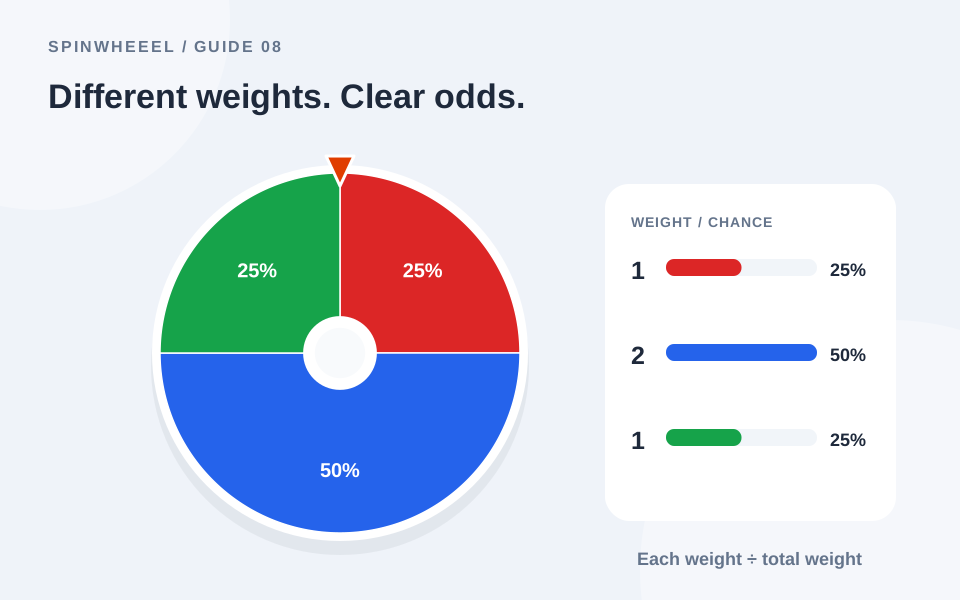
An entry’s chance on a weighted wheel is its weight divided by the total weight of all eligible entries. Equal weights give equal entry chances. Changing a weight, adding a duplicate, or removing a winner changes the setup and therefore may change the odds.
Understanding that rule is more useful than judging a wheel by its animation. A smooth spin is a way to present the selection; the list and its configured weights determine what can be chosen.
Equal Entries on a Random Picker Wheel
Suppose the wheel spinner contains four labels: Amber, Blue, Green, and Red. Each starts with weight one. The total weight is four, so each entry has a probability of 1 ÷ 4, or 25%, on a single spin.
The wheel’s design does not affect those chances. Switching to a different palette, changing a font, or turning the sound off leaves the same four entries and weights in place. Shuffling rearranges where the slices sit without changing their probabilities.
How Do Weighted Wheels Work?
Now give Blue a weight of two while the other three entries remain at one. The total is five. Blue has a 2-in-5 chance, or 40%, and each other entry has a 1-in-5 chance, or 20%.
| Entry | Weight | Chance per spin |
|---|---|---|
| Amber | 1 | 20% |
| Blue | 2 | 40% |
| Green | 1 | 20% |
| Red | 1 | 20% |
The numbers are relative, not percentages you type directly. Weights of one, two, and one produce 25%, 50%, and 25%. Weights of ten, twenty, and ten produce the same proportions. This tool accepts whole-number weights from 1 to 100.
A Bigger Weight Is Not a Guaranteed Win
A 40% chance means the entry is eligible for 40% of the probability space on each independent draw. It does not mean it must win four times in every block of ten spins. Short runs can differ from the long-run proportions.
Duplicate Names Change Combined Probability
A list of Ada, Bilal, Ada, and Chen has four equally weighted rows. Each row has a 25% chance, but Ada appears on two of them. The combined probability of seeing Ada is therefore 50%.
This may accurately represent two tickets belonging to one person. It may also be an accidental duplicate. The wheel cannot tell which interpretation you intended. Check the list before describing a draw as equal for each person.
Display Duplicate Names Is a Visual Setting
Turning off duplicate labels hides repeated text on the wheel. It does not delete repeated entries or remove their weights. Use the explicit Remove duplicates action when you want to change the list itself. Likewise, limiting the number of visible labels does not remove hidden entries from selection.
What Happens When You Remove a Winner?
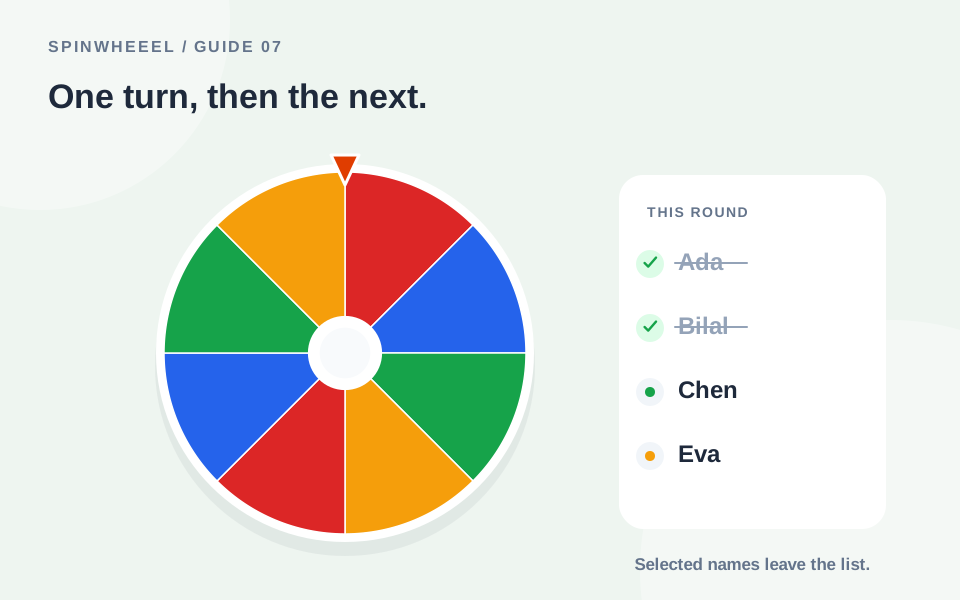
With four equal rows, each starts at 25%. If one row is selected and removed, the remaining three each have a 1-in-3 chance on the next draw. For unequal weights, divide each remaining weight by the new total.
Removing a row prevents that row from winning again. Another row carrying the same name can remain eligible. For unique-person draws, read how to pick names without repeats and clean the roster before starting.
How This Wheel Selects and Displays a Result
The tool uses the browser’s cryptographic random-number facility to select within the total integer weight. It then animates the wheel to the chosen slice. The pointer remains fixed while the wheel rotates beneath it.
Duration, sound, textures, and confetti are presentation settings. They do not change the chosen entry. Blind mode hides labels during the spin, and the label-limit setting controls displayed text. Neither changes the set of eligible entries.
This is a description of the tool’s selection model, not an independent audit certificate. A public giveaway still depends on a complete list, honest configuration, and a clear process.
Compare Unequal Weights with a Worked Example
Imagine a practice wheel containing Vocabulary with weight three, Reading with weight two, and Spelling with weight one. The total weight is six. Vocabulary has a three-in-six chance, or 50%; Reading has two in six, or about 33.3%; and Spelling has one in six, or about 16.7%. These percentages describe a single draw from that configuration.
If Vocabulary is selected and removed, the remaining total becomes three. Reading then has a two-in-three chance and Spelling has one in three. The original percentages no longer apply because an eligible weight has left the pool. This is why a sequence with removal needs a fresh probability calculation at each stage.
Check the Probability You Mean to Describe
Write down whether your claim concerns a row, a person, or a combined category. If two different rows both represent Vocabulary, add their weights before describing that topic's overall chance. If each row represents a separate person, equal row weights give equal chances only when each person appears the same number of times.
Review the list in Advanced mode before presenting a weighted activity. Sum the weights and calculate a few examples by hand so you can explain the setup clearly. Do not adjust a weight simply because a small trial produced an unexpected streak. Changing the configuration changes future probabilities; it does not correct or balance results that have already occurred.
QUICK ANSWERS
Questions About Spin Wheel Fairness
Is a repeated result evidence of a broken wheel?
No. With the winner kept eligible, repeated results are possible. A small number of spins is not enough to judge a probability model from the observed counts alone.
Does a longer spin make the result more random?
No. The result is selected before the presentation animation finishes. A longer duration changes the viewing experience.
Can I change the odds intentionally?
Yes. Edit weights in Advanced mode. Make those changes visible to participants when they matter to your activity; do not describe an unequal-weight setup as equal odds.
Does a yes-or-no wheel always mean 50/50?
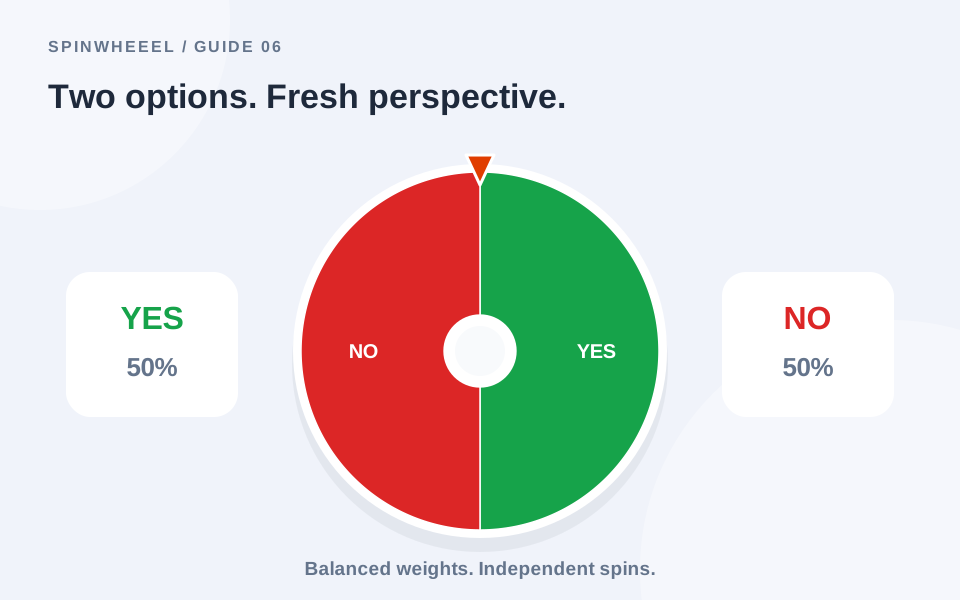
Only if the total weight assigned to Yes equals the total assigned to No. Our binary-choice guide shows how combined outcomes work.
Put it into practice.
Start with a few sample entries, check your settings, and make the wheel your own.
Open the wheel