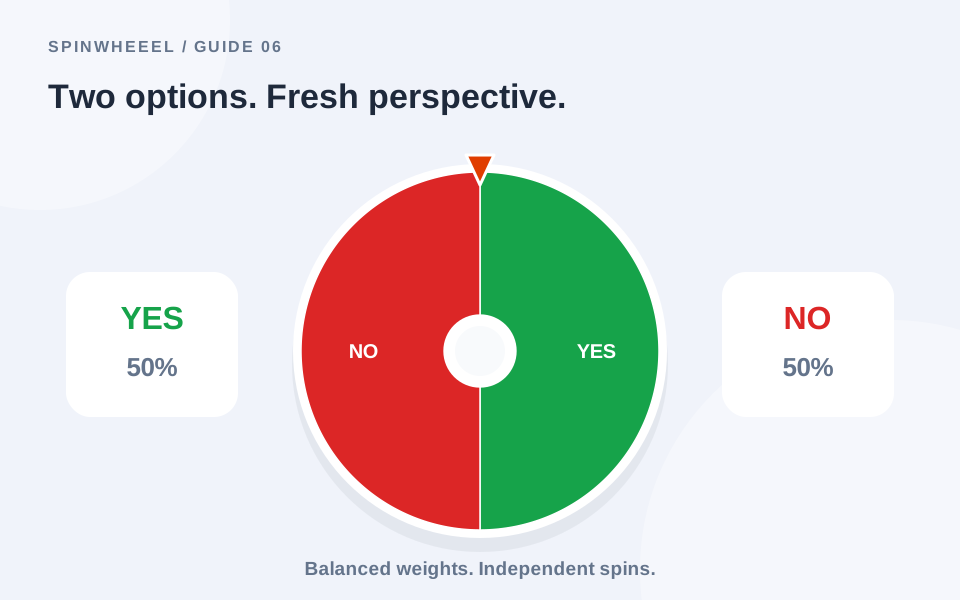
Use a yes-or-no wheel when you have a small choice with two acceptable outcomes and want a random tie-breaker. Choose the Yes / No preset, ask a clear question, and spin. With balanced total weights, Yes and No each have a 50% chance.
The wheel does not understand your question. It does not predict what will happen, assess risk, or provide personal advice. Its value is simpler: it gives you a visible way to stop circling around a minor choice.
Choose a Question the Wheel Can Actually Help With
A useful question names an action you control. Should we play one more round? Should we choose the park rather than the café? Should I start with the desk tidy? These can work as playful prompts when the alternatives are already reasonable.
A question such as Will my plan succeed? asks for information the wheel cannot supply. Rewording it does not give the random outcome predictive power. Use evidence, discussion, or qualified advice when a decision depends on facts or serious consequences.
Agree What Yes and No Mean
For a group choice, name both outcomes before the spin. If Yes means a park walk, decide what No means too. A clear fallback stops a binary question from creating another round of uncertainty.
How to Use a Yes or No Wheel
- Open the online wheel and choose the Yes / No preset.
- Check that the outcomes have balanced weights. The preset starts with one Yes and one No, each weighted one.
- Add your question as the title if you want it visible during the spin.
- Choose whether the result is a suggestion or an agreed tie-breaker.
- Press Spin the wheel and let the animation finish.
- Read the result and take the next practical step.
Leave winner removal off for independent yes/no spins. Removing Yes after a draw would leave only No for the next spin. That is a different process from repeatedly asking a balanced binary question.
What Makes a Yes-or-No Spinner 50/50?
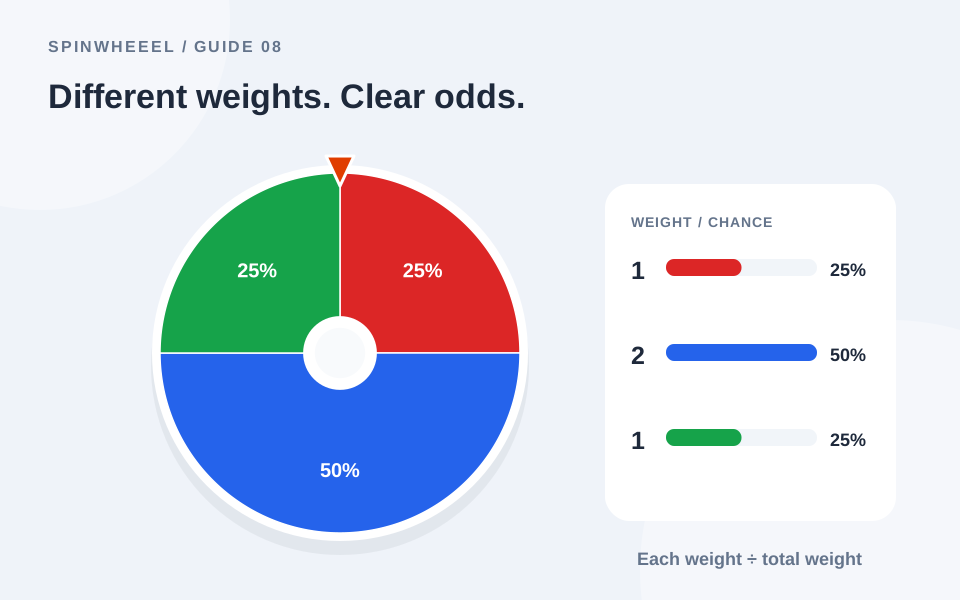
With one Yes entry and one No entry, both weighted one, the total weight is two. Each outcome therefore receives one half of the probability. The same balance would hold for four Yes rows and four No rows, provided their weights were equal.
Eight equal rows do not each have a 50% chance. Each row has a 1-in-8 chance, while the four Yes rows together add up to one half. This difference between an individual entry and a combined outcome is important whenever a label appears more than once.
Why the Same Answer Can Appear Again
Independent random spins do not have to alternate. Yes, Yes, No is possible, as is a longer run of one result. A small sequence is not evidence that the next result is owed to the other side. See wheel odds, duplicates, and independent spins for more examples.
Yes or No Wheel vs a Coin Flip
Both can represent two outcomes with equal chances. A physical coin is convenient when you have one nearby. A digital decision wheel lets you display the question, customize labels, show the result to a group, and record the recent results in the browser.
Neither method decides which option is better. Choose the format that fits the setting. If you need to compare several options, a custom list is a better fit than forcing everything into Yes and No.
Notice Your Reaction Without Treating It as Proof
You may feel pleased or disappointed when a result appears. That reaction can be a reason to revisit a preference, but the wheel has not diagnosed why you feel that way. You can choose differently for an informal personal prompt.
For a group rule, do not keep re-spinning until your preferred answer wins. Either accept the agreed process or explain why you want to stop and discuss the choice. For ongoing difficulty making decisions, a spinner is not a substitute for appropriate support.
When to Use More Than Two Options
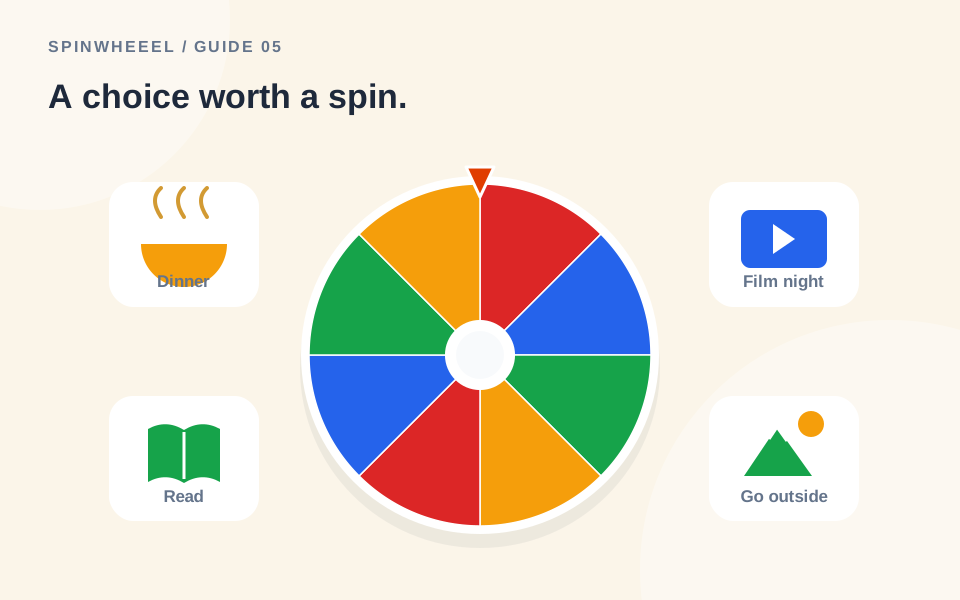
If your actual shortlist is Pizza, Noodles, Salad, and Soup, add those four entries to the wheel. Asking repeated yes/no questions about them can create an awkward process where the order of questions influences what gets considered.
The everyday decision wheel guide shows how to create a practical shortlist. The custom entry tutorial covers changing the labels.
Turn a Vague Yes-or-No Question into a Clear Choice
Compare Should we do something outside? with Should we take a twenty-minute park walk before lunch? The second question defines the activity and timing, so everyone can understand the result. Before spinning, also decide what No means. It might mean staying home to play a board game rather than reopening a list of unrelated possibilities.
Check both alternatives before adding the question as your wheel title. If the park is unavailable or one person cannot take part, the proposed Yes outcome is not ready for a tie-breaker. Replace it with a workable choice or discuss another plan. Random selection cannot repair an alternative that the group has already ruled out.
Use a Stopping Rule for Repeated Questions
For one informal choice, agree to one spin and then act on the result. Asking the same question repeatedly until the answer changes gives you several random outcomes without a clear way to choose between them. If the result is only a conversation starter, say that beforehand so nobody mistakes it for a binding group agreement.
For a new independent question, inspect the entries again and keep both outcomes eligible. A previous Yes does not need to be balanced by a No on the next spin. If you want a planned alternation between two activities, use a schedule instead. A balanced wheel describes the chances for each draw, not a promise about the order of future answers.
QUICK ANSWERS
Yes-or-No Wheel Questions
Does the wording of my question change the result?
No. The selection uses the entries and weights. The title only displays your question.
Can I add Maybe?
Yes, but that creates a third outcome. With three equally weighted entries, each outcome has a 1-in-3 chance, not 50%.
Is it a separate tool?
No. The Yes / No preset loads a simple configuration into the same customizable wheel on the homepage.
Put it into practice.
Start with a few sample entries, check your settings, and make the wheel your own.
Open the wheel